Adolescence rearranges almost everything that felt steady in childhood. Sleep shifts later, friendships intensify, schoolwork becomes more complex, and the inner monologue grows louder. In clinic rooms, I hear versions of the same sentence from teens and their parents, sometimes in the very first session: I do not feel like myself. The work of teen therapy is not to hand back a neat answer about who a young person is. It is to build a sturdy space where identity can be explored, tested, and owned, and where self-esteem grows from lived evidence rather than slogans.
Why identity and self-esteem wobble during the teen years
Identity is not a single choice. It is a series of bets, revised as a teen collects feedback from family, school, screens, and their own body. Brain development plays a role. The prefrontal cortex, which coordinates planning and impulse control, matures on a slower timeline than the limbic system, which amplifies emotion and reward seeking. That mismatch can create dramatic spikes in feeling and a pull toward immediacy, especially in social situations. At the same time, teens are doing more advanced thinking than in childhood. They compare, idealize, spot hypocrisy, and evaluate themselves against peers and cultural standards.
Self-esteem, the felt sense of worth and capability, rises and falls with that comparison process. A teen who excels on the soccer field may suddenly feel small in calculus. A student who has always earned praise for being easygoing may question whether that identity leaves any room for anger or disagreement. Social media tightens the screws. Curated images, visible metrics of popularity, and the permanence of digital footprints create a scoreboard that never turns off. When you add grief, family transitions, bullying, chronic illness, or neurodivergence, the identity project gains new layers of complexity.
Therapy does not make these pressures disappear. It changes how a teen meets them, and how the people around them respond.
What teen therapy offers beyond advice
Most teens already receive plenty of advice, some helpful, some contradictory. What they do not often have is a confidential, ritualized hour where their experience is the main data set. Advice tries to solve. Therapy starts by understanding. The difference shows up in small but crucial practices.
In the first sessions, I am less interested in problem lists than in daily rhythms. What time does sleep start, no matter what time the clock reads. When do anxiety spikes tend to appear. What does a good day actually look like. The goal is to map patterns, not pathologize them. From there, teen therapy offers three core pillars.
- A relationship that models respect and curiosity. Many teens test that relationship, sometimes by going quiet, sometimes by pushing boundaries. Done well, therapy neither collapses into a lecture nor slides into being a friend. It is a steady alliance with clear limits, which itself becomes an experience the teen can draw on when navigating other relationships. A lab for trying new behaviors safely. Teens get to practice saying no, requesting help, reframing a thought, or sitting with a feeling for sixty seconds longer than usual. The room becomes a rehearsal stage, then we export those skills to life between sessions. A shared language for what is happening. Name the thing, it gets a little less scary. Whether we call it a cognitive distortion, a shutdown, masking, sensory overwhelm, or a spiral, accurate words reduce shame and spark options.
The engine of change: attunement, boundaries, and pacing
Good attunement means the therapist tracks not just what a teen says, but how they say it. A half smile that does not reach the eyes. Jittery foot taps when school comes up. A drop in volume when talking about a friend group. We follow those micro-signals gently. Pacing matters. Pushing a teen to disclose quickly can rupture trust. Waiting forever can feel like avoidance dressed up as patience. The art is to titrate challenge with support, a small stretch followed by consolidation.
Boundaries are not rigid rules for the therapist’s benefit. They provide a safe frame, which paradoxically expands freedom. Clear expectations about confidentiality, limits around safety, and predictable session times form the reliable container teens need to take risks. When I explain how confidentiality works, I am explicit: our conversations are private unless there is a safety concern or you want me to share something. Most teens relax visibly, and they test the boundary with minor disclosures before bringing in the material that matters most.
Skills and approaches that actually move the needle
There is no single best modality for teen therapy. The right mix depends on the teen’s temperament, goals, and context. A few approaches routinely help with identity formation and self-esteem.
Cognitive behavioral therapy, or CBT, gives teens tools to notice and revise unhelpful thought patterns. A sophomore who thinks, I always ruin presentations, might build a habit of tracking counterexamples and converting absolutes into specifics. I ruined the conclusion once, I actually started strong. This is not positive thinking for its own sake. It is accuracy training, which leads to more realistic self-judgment and a stronger sense of agency. Over several weeks, a teen learns to write and test small behavioral experiments, like raising a hand once per class, then collecting data on what actually happens.
Dialectical behavior therapy skills help teens tolerate intense emotion without acting in ways they later regret. I have watched a junior who used to storm out of the house when criticized learn to pause for ninety seconds, splash cold water, and re-enter the conversation. That tiny pause opened a path to a different identity story, from I am explosive to I can feel fury and not let it steer the car. DBT’s blend of acceptance and change reduces black and white thinking about the self.
Acceptance and commitment therapy, ACT, places values at the center. Teens clarify what matters to them, not what earns the most approval, then practice actions aligned with those values even when anxiety or doubt shows up. A teen who values creativity may keep drawing despite low likes, a step that strengthens self-trust more than any external validation.
Narrative therapy treats problems as separate from the person and invites teens to re-author their story. The labels they have picked up, quiet one, bad kid, try-hard, become characters they can place on a shelf and examine. We ask, who benefits when you keep that label. What evidence supports a counter-story. Externalizing does not deny responsibility. It restores choice, and teens who regain authorship usually show a corresponding lift in self-esteem.
Expressive therapies, like art, music, or movement, reach teens who struggle with words or who have learned that words lead to trouble. I keep a simple assortment of materials in the office. Sharpies, sticky notes, a whiteboard, modeling clay. One teen who could not describe how social anxiety felt made a jagged clay landscape and then drew a flat road through it. That image became a visual anchor for breathing exercises and graded exposures. Less talk, more doing, better carryover.
Family therapy’s role in identity work
Identity does not grow in a vacuum. Family therapy can be the difference between a teen’s fragile new self-concept cracking at the first sign of conflict, and that self-concept hardening into something resilient. I ask parents and caregivers to look at three domains.
First, interaction patterns. Who speaks for whom, who interrupts, who shuts down, who finds humor that lands, who uses it to avoid. Families often fall into predictable dances under stress. Changing the dance, even by a beat, opens space for the teen to try a new step.
Second, communication about autonomy and safety. What decisions belong to the teen, which require collaboration, and which stay with the adults. When this hierarchy is not explicit, power struggles replace problem solving. Teens get to practice negotiating, adults get to practice saying no with clarity rather than anger.
Third, repair after conflict. Not all ruptures are preventable, but most are repairable. When a parent can name, I raised my voice, that likely felt scary, and here is how I want to handle it next time, the teen learns that relationships can flex and recover. Their internal story shifts from I cause chaos to conflict does not equal catastrophe.
Family therapy is not a referendum on parenting quality. It is a way to reduce ambient static so the teen’s efforts in individual sessions can translate at home. Sometimes the most powerful intervention is helping adults align on routines, like consistent sleep times or device rules after 10 p.m., which lowers reactivity across the board.
When ADHD testing clarifies the story
Teens who struggle with attention, organization, or impulsivity often receive personality labels before they receive accurate assessment. Lazy, careless, defiant, overly sensitive. ADHD testing, when warranted, can remove a boulder from the identity path. It is not about chasing a diagnosis to explain everything. It is about precision. A careful evaluation might include rating scales from home and school, a clinical interview that addresses sleep, mood, and learning history, and standardized tests that assess working memory, processing speed, and executive function.
Here is what changes when a teen learns, with evidence, that their brain processes information differently. They stop treating effort as moral worth. They can ask for supports without shame, like extended time, movement breaks, or visual planners. Parents and teachers shift from punishment models to skill building, which reduces conflict and builds competence. Identity becomes less about character flaws and more about knowing how one’s mind works.
There are trade-offs. A label can be overused, risk becoming an excuse, or shape peers’ expectations. Good practice keeps the focus on strengths and strategies. If medication is on the table, we discuss benefits and side effects in concrete terms, and we agree on how to monitor response over time. The teen stays in the driver’s seat of their story, informed by data.
Group therapy and the mirror of peers
Group therapy gives teens a powerful corrective to distorted self-views. In a well-run group, members learn that their private fears are often common. A teen who believes they are uniquely awkward hears five versions of the same social worry, and the ground shifts. Groups teach feedback skills, boundaries, and empathy with immediate social consequences. Say too much, and you see a peer pull back. Stay silent, and you notice how much you want to jump in. With good facilitation, these moments become practice reps.
I once co-led a six-week social anxiety group where members created micro-goals for each session, things like make eye contact during my check-in or share one funny story that flopped. By week four, one member who had not spoken above a whisper was telling a peer, I liked how you stuck with your example even when you lost your place. Self-esteem grows through these specific, earned moments.
Working with culture, gender, and online life
Identity work without attention to culture is incomplete. Teens negotiate expectations from multiple worlds at once, school culture, family culture, neighborhood, online communities, and often a country of origin or a faith tradition. When a teen says, I feel like a different person at home and at school, I do not rush to integrate those identities. Sometimes the healthiest move is learning to code switch with less shame and more choice.
Gender and sexuality exploration requires an extra layer of safety. Teens who are questioning or who identify as LGBTQ+ are doing identity work with higher stakes, given the potential for rejection or misunderstanding. Therapy helps them pace disclosures, build supportive networks, and set boundaries. Family therapy may focus on psychoeducation and on processing grief or fear that sometimes arise in caregivers, without putting the emotional burden back on the teen.
Online life is not optional background noise. It is part of identity construction. We address algorithms, privacy, FOMO, and the way digital platforms reward outrage or hot takes. I have asked teens to run small experiments, like a 48 hour muting of certain accounts, then to journal the effect on mood and self-talk. Gains are often measurable within days.
What progress looks like, in real terms
Early shifts can be subtle. A teen who used to shrug at every question offers a five word answer. Sleep stabilizes by thirty minutes. Late work drops from eight assignments to three. Parents report that arguments end five minutes sooner on average. Those increments matter because teens can feel change in their bodies before they can name it. Over two to three months, we usually see clearer markers. The teen initiates topics in session. They try a new activity or rejoin one they abandoned. They attempt skill use before a blow up, not just after.
I like metrics that do not depend only on mood ratings. A teen who tracks the number of times they check their phone during homework and reduces it by half has a concrete, shareable win. Another who used to avoid speaking in group projects now takes one slide and receives a neutral reaction rather than a feared humiliation. Self-esteem builds on that kind of evidence, layered week after week.
How parents can support between sessions
- Protect sleep like a prescription. Help your teen anchor a consistent wake time, dim lights at least an hour before bed, and keep phones out of the bedroom when possible. Self-esteem erodes quickly on chronic sleep debt. Ask questions that expand, not collapse. Try, What felt hard today and how did you handle it, rather than Why did you do that. Curiosity beats cross examination. Praise process and specifics. Swap Good job for I saw how you broke that assignment into two parts and started even though you felt stuck. Align rules and consequences ahead of time. Fewer, clearer expectations reduce power struggles and preserve the parent teen relationship as a resource. Model repair. If you lose your cool, say so without a list of reasons. I snapped. I do not like it. I am going to take a walk and try again in ten minutes.
Choosing a therapist and setting up care
- Look for people who work primarily with adolescents. Ask about training in CBT, DBT, ACT, or family therapy, and how they tailor approaches. Ask how they handle confidentiality and parent communication. You want a therapist who includes you appropriately without turning sessions into reporting meetings. Consider logistics as part of fit. After school slots, office location, telehealth options, and cost influence consistency, which influences outcome. If ADHD testing might be relevant, ask whether the clinician provides assessment or collaborates with testing providers. Clarify timelines and what the final report includes. Set expectations for pace. Identity work is not a sprint. Agree on how you will review progress together at four to six week intervals.
Edge cases and cautions
Not every teen is ready for direct identity exploration. In acute crises, like active suicidality, self-harm, or substance dependence, stabilization and safety planning take priority. Likewise, untreated sleep apnea, significant medical conditions, or unaddressed learning disorders can masquerade as mood or motivation problems. A careful intake screens for these factors so therapy does not chase the wrong target.
Perfectionistic teens may turn therapy into another grade to earn, arriving with lists of insights and little willingness to feel. In those cases, we slow the cognitive engine and prioritize embodied work, breath, movement, micro-exposures to uncertainty. On the other end, some teens avoid content with jokes or vague positivity. The task there is to build tolerance for specificity. Who said what, what did you feel in your chest, what happened right after.
Families sometimes hope therapy will change only the https://www.everyheartdreamscounseling.com/about-kaseycopeamft-therapist teen. When the home environment reinforces old roles, gains fade. That is where family therapy helps translate individual progress into shared routines. The therapist should be transparent about this and invite parents into the process without shaming them.
A composite vignette from practice
Maya was a 15 year old sophomore referred for low mood, irritability, and slipping grades. She described herself as a people pleaser who could not say no. Her parents said she spent hours on homework but had little to show for it. In session, she was polite, thoughtful, and vague. Sleep ran from 1 a.m. To 6:30 a.m. She reported intense stomach pain on school mornings that improved on weekends.
We mapped a week. The pattern showed long after school stretches of screen time under the banner of research, followed by panic around 10 p.m., followed by late night productivity that collapsed after midnight. Socially, she was caught between two friend groups after a rumored text thread about her. She had not confronted anyone and carried a belief that if she set boundaries, she would be abandoned.
We started with physiology to get quick wins. A two week sleep plan, anchored to a consistent wake time, no caffeine after 2 p.m., and a 30 minute buffer without screens at night. Parents shifted wi-fi to a family dock at 10 p.m., framed as an experiment, not a punishment. In session, we used CBT to unpack an all or nothing thought, If I say no to group study, they will stop inviting me. She ran a small test, declining one study session with a clear reason and proposing a different time. No one dropped her. That was a bankable deposit.
Given the procrastination, we screened for ADHD. Rating scales suggested possible inattentive symptoms, especially with task initiation and working memory. After full ADHD testing, the data supported a diagnosis. That changed our plan. We added visual planners, chunked assignments, movement breaks every 25 minutes, and a short acting stimulant trial with careful monitoring. Her grade recovery was not linear, but her hourly productivity improved noticeably, and stomach pains eased as mornings grew less chaotic.
We invited her parents for family sessions. We worked on moving from interrogations to check-ins, and on sharing household tasks so Maya was not both student and default caregiver for younger siblings in the afternoons. In parallel, we used narrative therapy to help Maya rename people pleasing as a strategy she learned to keep connection, not a fixed trait. By month three, she had two new sentences she would use in session and then at home. I need a minute to think about that and I cannot do tonight, try me Friday. The first time she said that to a friend, she shook. The friend said, okay.
Her self-esteem did not magically soar. It grew, session by session, from evidence that she could feel fear, take action, and survive the outcome. By the end of the semester, she described herself differently. Still kind, still collaborative, but not at the cost of disappearing.
The long view
Identity work continues long after therapy pauses. The best measure of success is not a permanent absence of doubt or sadness. It is the presence of tools, a more accurate internal narrator, and relationships that can weather conflict. Teens who practice in therapy carry forward a felt memory, I have done this before, I can do hard things, I have people. That memory steadies them in the next round of growth, whether it is a new sport, a first job, or a hard conversation with a friend.
Parents often ask when to stop. I suggest looking for three signs. The teen initiates use of skills without heavy prompting, they can name values and choices even under stress, and family interactions support rather than undermine those efforts. At that point, spacing out sessions or pausing makes sense. Life will supply new challenges. Therapy remains available as a booster, not a crutch.
Identity and self-esteem are not trophies to win once. They are practices. Teen therapy gives those practices structure, language, and momentum. With thoughtful use of individual therapy, family therapy, and targeted tools like ADHD testing when indicated, teens build a self they can recognize, defend, and grow into. That is quieter work than social media makes it seem, and far more durable.
Address: 1190 Suncast Lane, Suite 7, El Dorado Hills, CA 95762
Phone: (530) 240-4107
Website: https://www.everyheartdreamscounseling.com/
Email: [email protected]
Hours:
Monday: 9:00 AM - 8:00 PM
Tuesday: 9:00 AM - 8:00 PM
Wednesday: 9:00 AM - 8:00 PM
Thursday: 9:00 AM - 8:00 PM
Friday: 9:00 AM - 8:00 PM
Saturday: Closed
Sunday: Closed
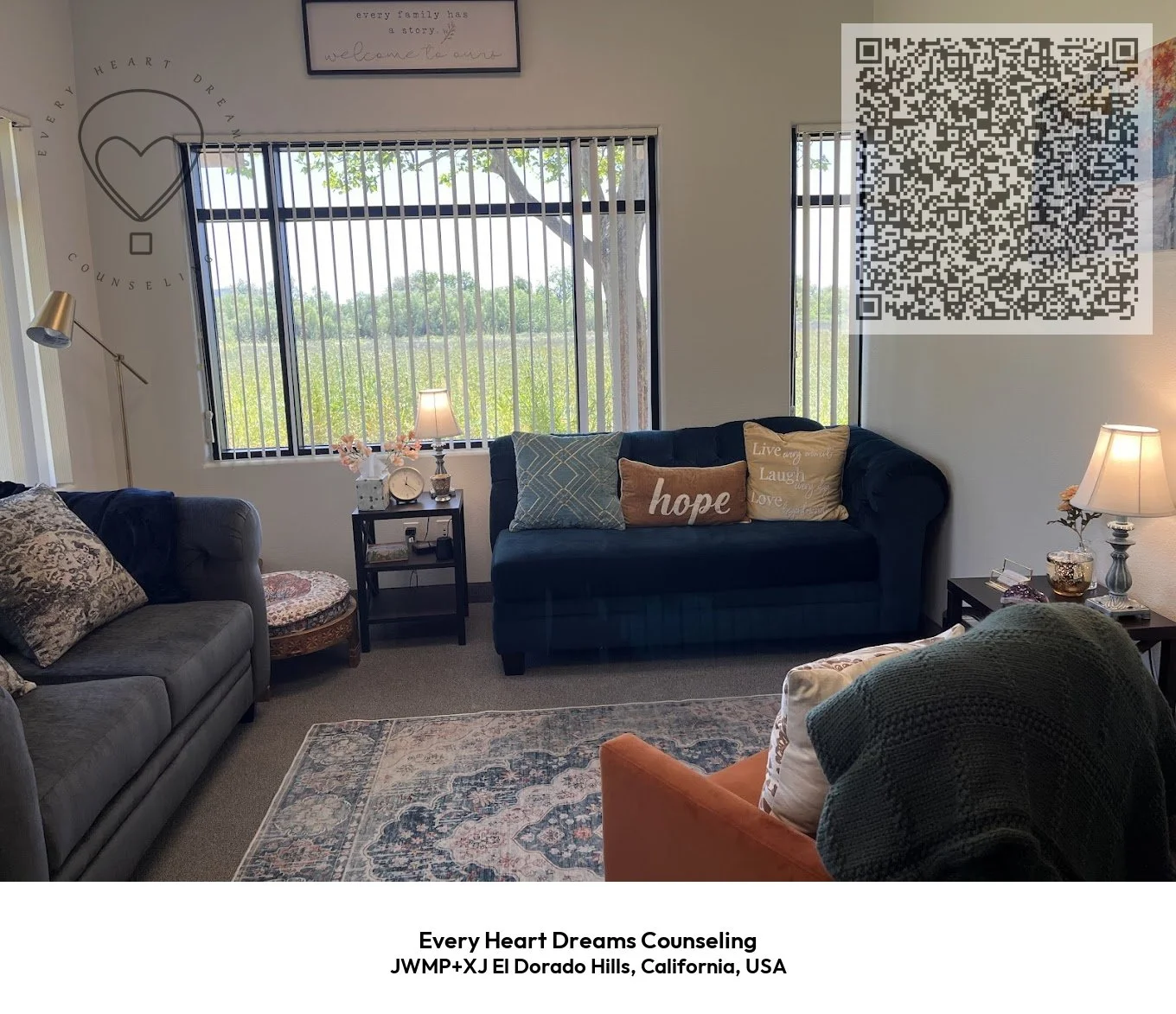
Open-location code (plus code): JWMP+XJ El Dorado Hills, California, USA
Map/listing URL: https://maps.app.goo.gl/QkM4GXutsKBynwmB9
Embed iframe:
Socials:
https://www.instagram.com/erinneverhartlmft/
https://www.facebook.com/everyheartdreamscounseling/
The practice works with children, teens, young adults, adults, couples, and families who need support with trauma, anxiety, depression, relationship struggles, emotional immaturity, and major life stress.
Clients in El Dorado Hills can explore services such as family therapy, teen therapy, adult therapy, child therapy, ADHD testing, cognitive assessments, and personality assessments.
Every Heart Dreams Counseling uses an integrated trauma treatment approach that may include DBT, EMDR, Brainspotting, IFS, and trauma-informed yoga depending on client needs.
The practice offers both in-person sessions in El Dorado Hills and telehealth options for clients who prefer added flexibility.
Families and individuals looking for trauma-focused counseling in El Dorado Hills may appreciate a practice that combines relational support with behavioral and somatic approaches.
The website presents Every Heart Dreams Counseling as a compassionate group practice led by Erinn Everhart, LMFT, with additional support from Devin Eastman.
To get started, call (530) 240-4107 or visit https://www.everyheartdreamscounseling.com/ to request an appointment.
A public Google Maps listing is also available for location reference alongside the official website.
Popular Questions About Every Heart Dreams Counseling
What does Every Heart Dreams Counseling help with?
Every Heart Dreams Counseling helps children, teens, young adults, adults, couples, and families with trauma, anxiety, depression, relationship conflict, emotional immaturity, self-injury concerns, and related mental health challenges.
Is Every Heart Dreams Counseling located in El Dorado Hills, CA?
Yes. The official website lists the office at 1190 Suncast Lane, Suite 7, El Dorado Hills, CA 95762.
Does the practice offer in-person and online sessions?
Yes. The contact page says sessions are currently available in person and via telehealth.
What therapy approaches are listed on the website?
The website highlights integrated trauma therapy using DBT, EMDR, Brainspotting, IFS, and trauma-informed yoga.
Does the practice provide testing and assessment services?
Yes. The website lists ADHD testing, cognitive assessments, and personality assessments.
Who leads the practice?
The official website identifies Erinn Everhart, LMFT, as Clinical Director and Owner.
Who else is part of the team?
The site also lists Devin Eastman, LPCC, PsyD Student, as part of the practice.
How can I contact Every Heart Dreams Counseling?
Phone: (530) 240-4107
Email: [email protected]
Instagram: https://www.instagram.com/erinneverhartlmft/
Facebook: https://www.facebook.com/everyheartdreamscounseling/
Website: https://www.everyheartdreamscounseling.com/
Landmarks Near El Dorado Hills, CA
El Dorado Hills Town Center is one of the best-known local destinations and a practical reference point for people searching for counseling nearby. Visit https://www.everyheartdreamscounseling.com/ for service details.
Latrobe Road is a familiar local corridor that helps many residents place services in El Dorado Hills. Call (530) 240-4107 to learn more.
US-50 is the main regional route connecting El Dorado Hills with nearby communities and is a useful reference for clients traveling to appointments. Telehealth sessions are also available.
Folsom is closely tied to the El Dorado Hills area and is a common reference point for people looking for therapy in the broader region. The practice serves individuals and families in person and online.
Town Center Boulevard is another recognizable landmark area for local residents seeking nearby mental health services. More information is available on the official website.
El Dorado Hills Business Park corridors help define the broader local setting for professional services in the area. Reach out through the website to request an appointment.
Promontory and Serrano neighborhoods are familiar community reference points for many local families in El Dorado Hills. The practice offers child, teen, adult, couple, and family therapy.
Folsom Lake is one of the region’s most recognizable landmarks and helps place the practice within the larger El Dorado Hills and Folsom area. The website explains the therapy approach and specialties.
Palladio at Broadstone is another useful point of reference for people coming from nearby Folsom communities. Every Heart Dreams Counseling offers trauma-informed support with both office and telehealth options.
The El Dorado County and Sacramento County border region makes this practice relevant for families seeking counseling in the greater foothill and suburban Sacramento area. Visit the site for current intake details.